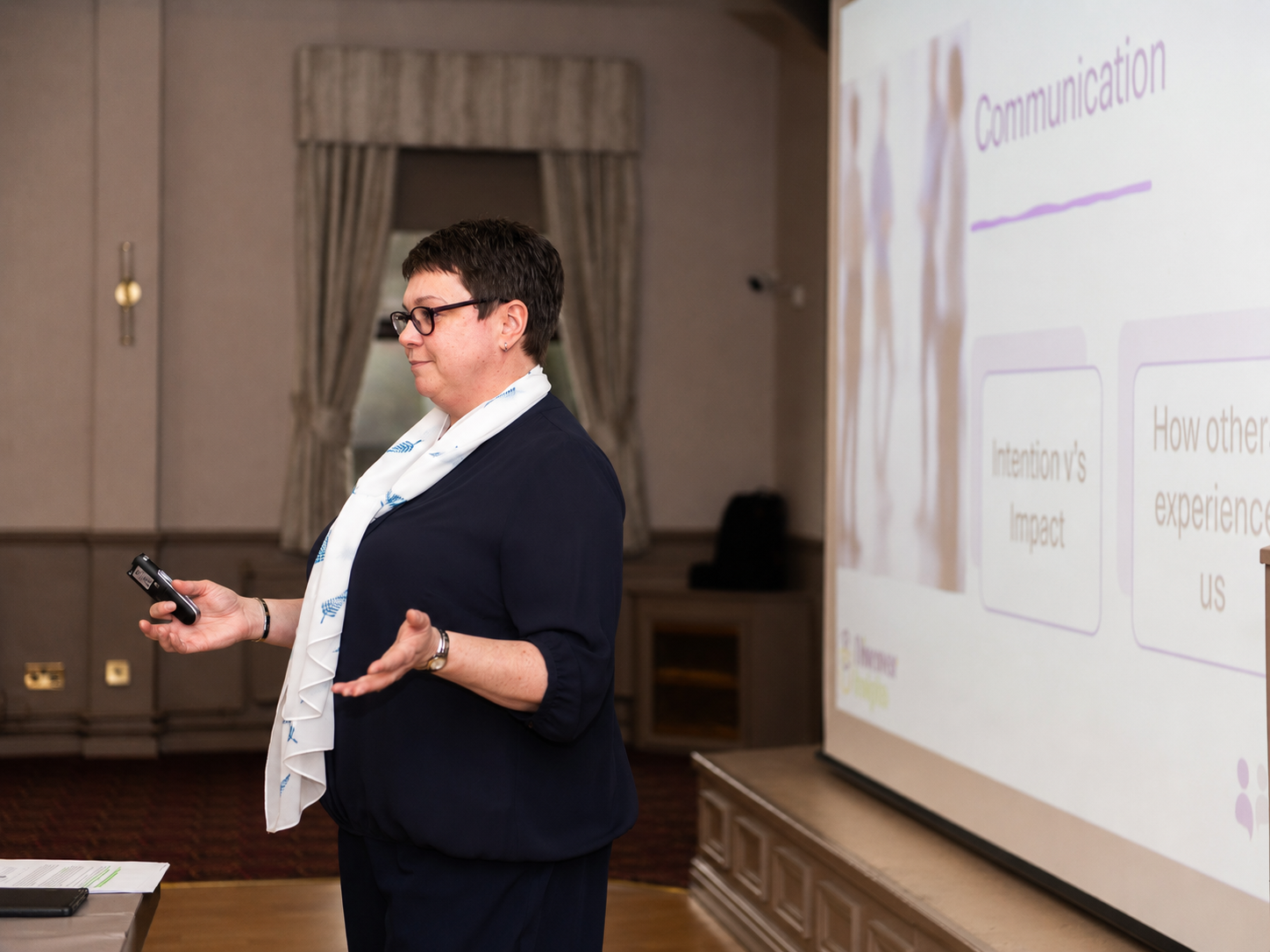
Good people can misunderstand each other at work, and those misunderstandings can quietly add to the pressure leaders already carry. Messages that feel clear and reasonable to one person can land very differently for another, particularly when deadlines, expectations and emotions are involved.
In my recent blog post about communication and leadership pressure I gave an example about how when a leader sends an email that simply says “Can we all move faster on these client responses please?” that one message that will be received in numerous different ways.
These differences are not about one person doing something ‘right’ and another person doing something ‘wrong’ what is happening is that people are interpreting things from different internal starting points.
Let’s explore now why communication is rarely just about words.
Workplace communication
In professional service firms’ effective communication really matters because of the nature of the work, often it is time-bound and quality sensitive as well as potentially emotionally loaded.
Generally, the more pressured the environment the less space people have to check assumptions or interpret carefully and in a calm and considered manner, which can have a detrimental effect on communication. This is one of the reasons why most workplace misunderstandings happen in ordinary moments, quick emails, deadline reminders, feedback conversations, silence in a meeting or a question asked at the wrong time.
Those types of misunderstandings though can add to the pressure of leadership because leaders end up smoothing things over, re-explaining, mediating or even stepping back in.
The same message can create different experiences
Every time you communicate with someone, the message that you intend to convey leaves you and then when it is received by the person you are communicating with something important happens.
That message runs through their own internal filters, expectations and beliefs, ones that are most often rooted in someone’s subconscious, that will interpret and, in some cases, even distort it.
Let’s go back to the example of a simple email, no matter what the message there is a chance that someone else will receive it differently.
For example:
- An email designed to convey some sense of urgency could sound like pressure to the person receiving it
- Someone with a direct communication style could sound like they are being critical of the other person
- Questions can feel challenging to someone who worries about the impact of making wrong choices
- Silence in a meeting or conversation can be misinterpreted as agreement
- Someone asking for more detail can look like they are being resistant or negative
This means that what is said by a leader is not always the same as what is heard by the employee and so while the leader may think that they have been clear the team may have experienced the tone, pace or intention differently.
Personality shapes what people notice first
As humans we all have our own unique personalities which have their own balance of style and ‘flavour’ and it is those that shape what people will notice first in any situation.
For example, some people will notice the bottom line first, some notice the ‘people’ impact of situations or decisions, some notice the amount of stability and pace, whilst others notice detail, risk and accuracy.
It also shapes perceptions of other people:
- A fast-paced leader may experience a slower, more reflective person as hesitant and get frustrated, but the more reflective person may experience that same fast-paced leader as rushing or dismissive.
- A detail-focused person may ask questions to create a greater degree of clarity, while someone else may hear those questions as negativity or resistance.
The reason I encourage personality awareness, particularly for leaders and managers, is not to facilitate some kind of system to allocate ‘labels’ to people, but to help create more understanding that can strengthen compassion and empathy and ultimately give people more choice in how they respond.
Pressure makes patterns more visible
In a pressured environment we don’t act as someone different, we just become a more exaggerated version of the person we already are. We default to the known and the familiar patterns of behaviour that we have learned to adopt to cope with situations.
Those coping strategies can look like:
- Stepping in more quickly and taking control of a situation
- Talking situations, thoughts and feelings through more often and with more people
- Withdrawing from the situation or the people
- Going through everything multiple times slowly, carefully and methodically to double-check
As a leader the danger is that when you misread these responses within your employees, for example seeing someone trying to gain more control as arrogance, or mistaking withdrawal as disengagement, seeing questions as challenge, talking as lack of focus.
It is human nature to seek a sense of control, approval or security and so effective communication and so as a leader the best first step is that of self-awareness about your patterns under pressure.
Behaviour has something underneath it
Underneath the behaviours we see are behaviours or emotional drivers, beliefs or protective responses which influence our response to any situation.
Things like:
- Fear of getting it wrong
- Wanting to avoid conflict
- Needing to feel helpful
- Wanting certainty
- Needing to maintain standards
- Wanting to be valued
This means that behaviours that we might refer to as ‘difficult’ are not always borne from an intent to be difficult. As a leader it will not be possible for you to analyse everyone, but it is helpful if you start to become more curious about the ‘why’ of the behaviour before you react.
Misunderstanding grows when people stop checking assumptions
Making assumptions is a trap that we can often fall into, you know the ones I mean, “they are being difficult”, “they do not care”, “they are avoiding responsibility”, “they should know what I mean”. The assumptions get formed when there is a pattern of response from someone that starts to feel familiar, we then begin to expect that response every time, and we stop questioning whether that is really true for every situation.
The challenge is that the human mind looks for proof of everything we tell it, and that includes assumptions, and this can then shape our own behaviour and communication style. For example, if we go into a conversation with an assumption that someone is going to be negative or critical, then not only is our mind going to go looking for the negativity, but our communication is likely to be more defensive in nature.
As a leader if you make assumptions about the capabilities of the people around you then you can end up becoming more central to everything because you become the fixer, the decision maker, the translator of even the safety net.
We can also assume that everyone thinks, reacts and wants to communicate the same way as us and this is not the case. The aim of the leader is not to get everyone to communicate in the same way, but to understand where interpretation is happening and assumptions are being made.
Some questions for you to consider
- Where have I assumed someone understood me because I was clear in my own head?
- What might have been heard differently from what I intended?
- When pressure rises, do I become quicker, quieter, more controlling, more detailed, more accommodating or more avoidant?
- Who in my team communicates very differently to me, and what might they need more of to feel clear?
- Where might someone’s behaviour be a protective response rather than a lack of care?
- What could I check before I react?
Final reflection
Good communication is not about becoming someone else or always saying the perfect thing, because neither of those things are possible in the real world. Instead, I would encourage you to become more aware of the patterns you bring into conversation and then begin to be more curious about the patterns other people bring too.
If this is something that you would like a chance to explore more deeply keep an eye out for more information on my “Why Good People Misunderstand Each Other at Work” webinar.